The global 2G and 3G shutdown is accelerating
The global retirement of 2G and 3G networks is accelerating as mobile operators modernize infrastructure and make more spectrum available for 4G and 5G.
This guide explains the latest 2G and 3G shutdown status by country, upcoming sunset dates, and what businesses should do to prepare.
According to the Global mobile Suppliers Association, 313 completed, planned or ongoing 2G and 3G switch offs had been identified across 89 countries and territories by the end of June 2026. For 2G specifically, 139 operators in 70 countries and territories have either completed or planned shutdowns. For 3G, 174 operators in 67 countries and territories have completed, planned or started shutdowns.
There is no single global shutdown date.
Timelines differ between countries and between operators within the same market. In some countries 3G has already disappeared while 2G remains available, often because older IoT and machine to machine equipment still depends on it. In other markets both legacy technologies have already been retired.
Global 2G and 3G shutdown overview
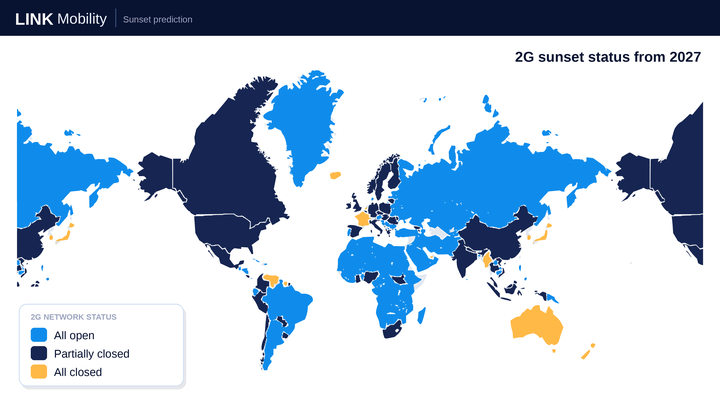
Telenor IoT analysis, April 2026: The 2G sunset map shows a mixed global picture, with 2G expected to remain available longer in some regions because of legacy IoT, emergency services, payment systems, and low-bandwidth use cases. Based on completed, announced, and planned 2G network sunset information from telecom operators. Future dates may change as operator plans evolve.
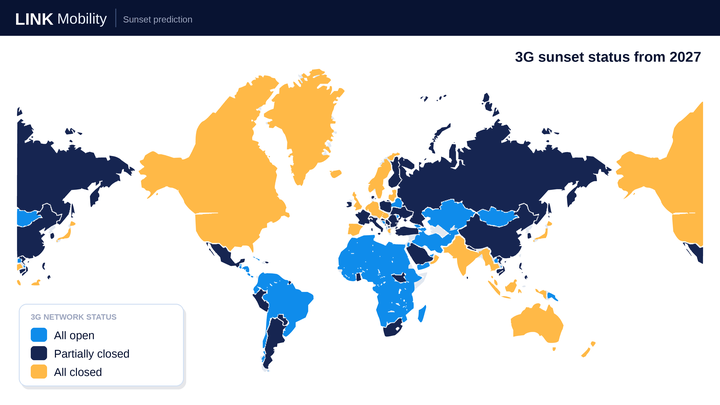
Telenor IoT analysis, April 2026: The 3G sunset map shows that many markets are expected to have completed or advanced 3G shutdowns by the end of 2027, although availability varies by country and operator. Based on completed, announced, and planned 3G network sunset information from telecom operators. Future dates may change as operator plans evolve.
Why 2G and 3G are being switched off
2G and 3G were important milestones in the development of mobile communications, but their use is declining as newer network technologies become more widely adopted.
GSA identifies several benefits from retiring legacy networks, including freeing spectrum for LTE and 5G, reducing the energy needed to operate networks carrying relatively little traffic, and moving toward newer technologies with improved security capabilities.
GSA also reports that 2G and 3G switch offs are occurring across most regions and that momentum has increased since 2024.
The order in which the technologies disappear can differ. Some operators retire 3G first while keeping 2G available for longer because of legacy voice, IoT and machine to machine services.
Not every shutdown has a fixed date
An important part of the global picture is that many planned network closures do not yet have a specific deadline.
GSA reports that 25 networks were planned for shutdown during the second half of 2026, excluding 37 networks already in the process of being switched off. Most of the 82 networks with future shutdown plans had not yet been allocated a specific date.
GSA's planned timeline includes 2G and 3G shutdown activity across 2026, 2027, 2028, 2029 and 2030, alongside additional networks for which no specific date has been set.
This makes it important for international businesses to monitor individual operators rather than relying on a single regional or global deadline.
More than mobile phones are affected
Legacy network retirement reaches beyond older mobile handsets.
2G and 3G connectivity may still be used by alarms, payment terminals, meters, connected vehicles, tracking equipment and industrial IoT applications.
GSA specifically identifies machine to machine and IoT connections as a challenge because some industries have very long equipment replacement cycles. Devices that are not updated to support LTE or 5G can lose connectivity when the legacy network they depend on is switched off.
This can make legacy network migration considerably more complex than simply replacing older smartphones.
Shutdowns can take longer than expected
Network retirement is not always completed according to the first announced schedule.
GSA notes that some previously announced targets may not have been met and says the process is likely taking longer than expected because of the difficulties associated with switching off older networks.
This reinforces the need to confirm current information directly with connectivity providers.
Different markets have different timelines
The United Kingdom is a good example of how 2G and 3G timelines can differ.
Ofcom confirms that the UK's major operators have already switched off their 3G networks. EE plans to begin switching off 2G from May 2029, O2 from summer 2029 and Vodafone during 2030.
Orange's 2G shutdown in mainland France is taking place progressively during 2026, while the operator plans to start shutting down 3G from the end of 2028.
Deutsche Telekom currently plans to completely switch off its 2G network on 30 June 2028 and reuse the released frequencies for 4G and 5G.
These examples show why a country cannot always be assigned one simple legacy network shutdown date.
Businesses should identify their legacy network dependencies
Organizations operating connected equipment should identify devices that may still rely on 2G or 3G and determine which operator provides connectivity in each market.
Particular attention should be given to equipment with long lifecycles and devices installed outside an organization's direct control.
Depending on the use case and local network availability, migration options can include LTE, 5G and technologies designed specifically for IoT connectivity.
Businesses should work with mobile operators and equipment suppliers to determine the most appropriate migration path for each device or service.
Communication is part of the transition
Where affected equipment is installed in customer homes, businesses, vehicles or other locations, migration can also require customer communication.
Organizations may need to explain why a service is changing, identify affected users, coordinate equipment replacements and provide reminders before local shutdown deadlines.
Messaging channels such as SMS, RCS and WhatsApp can support these customer communication journeys and help businesses manage migrations across larger customer bases.
A global transition with local timelines
GSA expects the pace of 2G and 3G switch offs to accelerate as operators continue modernizing infrastructure and reallocating spectrum and resources toward 4G and 5G.
The direction is global, but the timelines remain local.
For businesses operating across multiple markets, the key is understanding where devices still depend on 2G or 3G, which operator provides that connectivity and when that particular network is expected to disappear.
Want to make sure your customer communications are ready for the 2G and 3G shutdown? Book a meeting with LINK Mobility to discuss how SMS, RCS, WhatsApp and other messaging channels can help you keep customers informed throughout the transition, or contact us to learn more.